Deaf Interpreters: In the Blind Spot of the Sign Language Interpreting Profession?

| March 6, 2013 | 30 Comments

Sign Language Interpreter Consider the Position of Deaf Interpreters in the FieldA few weeks ago, I was looking through StreetLeverage posts and as I neared the end- perhaps even after I had looked at all of the titles—I realized that I had not seen anything explicitly about Deaf interpreters.

Of course, the phrase “sign language interpreters” appeared often, and of course Deaf interpreters are included in that population. Still, I thought, I have read several articles since StreetLeverage began and I couldn’t help but feel like they were written with hearing sign language interpreters in mind. (For the purposes of this post, when I say “hearing” interpreters, I am also referring to coda interpreters; I am using the label to refer to auditory status, not cultural identity.)

I contacted Brandon, asking if this observation was accurate, and he invited me to write about it. (Let that be a lesson to anyone else thinking about piping up—you may have to follow through on your thoughts!)

Are Deaf Interpreters Invisible?

What does it mean that I hadn’t even noticed the absence of posts about Deaf interpreters for a year and a half? Does it send a message, unintentional but unmistakable, that I do not think about Deaf interpreters often; that they are invisible; that they are unimportant to the field?

I am reminded of an observation that was shared with me recently about another instance of the absence of Deaf interpreters. In my area, there is a group of freelancers who run a website for direct contracting of sign language interpreting services. I do not work through this site, but I know many of the interpreters who do. I like many of them, I respect many of them, I have sought many of them out to team with me. When people ask how to find an interpreter, I include this website among my list of referrals. In short, this network of freelancers is by no means new or unfamiliar to me. Yet, I never noticed that there are no Deaf interpreters on their site. What does it say to my Deaf colleagues that I never even noticed—that their presence is not missed?

The Organizational Level: Overt Messages

Upon looking through online resources, Deaf Interpreters are an unmistakable and long-standing part of the profession. Certifications have been offered to Deaf interpreters for as long as they have been offered to hearing interpreters. According to RID’s CDI bulletin, the Reverse Skills Certificate has been awarded since 1972- the same year that certification began for hearing interpreters- and was primarily awarded to Deaf Interpreters. Twenty years later, development of the Certified Deaf Interpreter (CDI) exam began as result of a 1989 vote that “a generalist Certificate of Relay Interpreting be established for Deaf persons.”[i]

During the National Consortium of Interpreter Education Centers’ 2005-2010 grant cycle, they “delineated the unique competencies required of Deaf Interpreters in a document titled Toward Effective Practice: Competencies of the Deaf Interpreter (available at www.DIInstitute.org).” In the current grant cycle from 2010-2015, the Northeastern University center (NURIEC) is piloting a curriculum for Deaf interpreter education called Road to Deaf Interpreting. A total of 34 interpreters from two cohorts have already graduated from the program, and the 2012-2014 session is currently underway.[ii]

In 2007, RID assembled a taskforce to revisit the application criteria for taking the CDI exam. In the same year, NCIEC conducted a survey of Deaf interpreters and got 196 responses- a number that surpasses the estimated 162 Deaf interpreters listed in RID.org.[iii] Assuming the number of certified Deaf interpreters is accurate, then Deaf interpreters represent 2% of the 9,846 people listed as certified on RID.org.

On StreetLeverage, when you search the phrase “deaf interpreter” you get 5 results out of the 67 total posts, for a rate of 7%.[iv] Not bad. At the organizational level, then, there seems to be a proportionate level of attention paid to and recognition of Deaf interpreters. What happens at the individual level?

The Individual Level: Covert Messages

Using myself as an example (for better and for worse), I have worked alongside Deaf interpreters in various capacities: in a platform setting as a hearing team, in situations where Deaf interpreters are working with DeafBlind consumers, sometimes from my interpretation and sometimes not, and in situations that involve Deaf consumers with intellectual disabilities. When I began my career, I worked with a deaf independent living center and the deaf counselors often served as de facto Deaf interpreters. I can think of many enriching experiences working with and watching Deaf interpreters at work.

Jennifer Kaika - Sign Language Interpreter

Jennifer Kaika

At the same time, I have been guilty of not asking if Deaf interpreters have been assigned to a job that I’m on, even when I have reason to believe they would be. I don’t always think to share prep materials with Deaf interpreters until the day of an assignment- often not until we’ve all arrived. When I’ve been in touch with hearing teams to prepare for assignment, I don’t always include Deaf interpreters (again, usually because I haven’t asked if they were assigned.) What messages are sent when I consistently forget about my Deaf counterparts? Is there a reason I seem to consistently forget?

Is Frustration the Impetus?

There have been times where I have been frustrated by experiences working with a Deaf team—perhaps because they were new, perhaps because they had a different view of how to approach interpreting or teaming, perhaps because they usually work with DeafBlind consumers but I expect them to excel when working with consumers with different linguistic needs. Is this the reason I forget? If it is, does that mean that I hold Deaf interpreters to a double standard? After all, I have had similar experiences with hearing interpreters.

The range of experience and professionalism I have seen among DIs and CDIs parallels that of hearing interpreters: some are new, some have years of experience, some are certified, some are not, some have specializations, some are generalists, some aim to work at the national and international level, others aim to practice only in their local communities.

Should this range or these less-than-ideal experiences deter us from working together? Or can they become opportunities for us to talk openly about what wasn’t working?  Can they serve as opportunities for us all to be more specific about what skills we possess and what skills we are asking for when making a request to work with a Deaf interpreter?

Group Dynamics: Unintended Messages

Four years into my interpreting career, and only months after becoming a full-time freelancer, I had taken a staff position at Gallaudet University. Not long after coming aboard, discussions surfaced about speaking versus signing around the office and on campus. I had grown up on this campus. As a coda, I was accustomed to talking in front of my deaf relatives—whether to hearing friends or on the phone. All throughout my childhood and into my college years, I knew very few hearing people who could sign; thus, I spoke to hearing people and signed with Deaf people. All of this to say that the issue of hearing people speaking to each other when Deaf people were around was foreign to me. I was in need of an explanation.

Deaf people talked about feeling shut out—that choosing to speak when you could sign was exclusionary. Some hearing people said it was their right to use their first language. Deaf and hearing people talked about incidental learning—the ability to “overhear” a conversation and learn from it in the way you might pick up on the fact that people are talking about a bad storm approaching or some tidbit of news. This was pretty convincing, but still I wondered would it really be that big of a deal if I just talked with a hearing person and started signing when a deaf person came around? Then they could see what we’re saying and join the conversation if they wanted. When someone said that they wouldn’t even join the conversation if I weren’t already signing, I finally got it.

Nobody wants to disrupt their environment, you don’t want things to change just because you’ve walked into a room; you just want to be able to feel like you belong- no matter where you go.

Apply this same thinking to local and national RID conferences. Do we create spaces in the informal areas that send the message that Deaf interpreters belong there? On the organizational level, I would say yes. At the 2011 conference, I believe each Board member signed when they presented on stage. But as I recall, the hallways and social areas presented a different story.

The estimated 162 certified Deaf interpreters mentioned earlier represent 31 states.[v] In the directory on the Deaf Interpreter Institute, there are 35 interpreters listed representing 22 states. Between the two groups, 33 states are represented. If we truly believe that Deaf interpreters are a part of our profession—a long-standing and lasting part, present since the inception of RID, another way to connect to the Deaf community and maintain Deaf-heart, then wouldn’t our actions be aligned with our messages?

Addressing the Fundamental Question

Does the presence of DIs remove our status in the room as the ‘experts’ on sign language and interpretation in a way that is different than working with another hearing interpreter? Does it challenge a hearing interpreter’s ability to be “in control” of the environment? Does it raise questions about the quality of our work? Does all of this (and thus, the presence of a Deaf interpreter) make some of us nervous?

Have you grappled with some of these same questions? Do some of these experiences mirror your own?

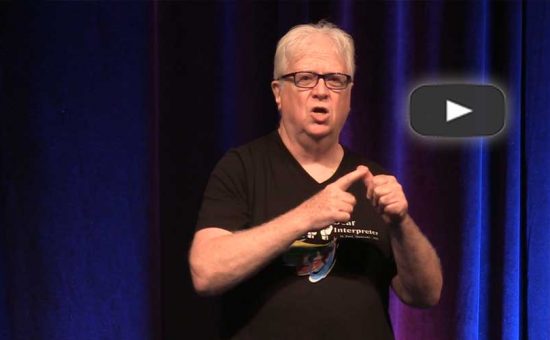
I think these are some of the things that Nigel Howard addressed in his StreetLeverage -  Live 2012 | Columbia, MD presentation, Deaf Interpreters: The State of Inclusion, in November of 2012, bringing up “the perception that ASL-English interpreters have that requesting to work with a deaf interpreter is an indication of an “inferior skill-set” and the “need to broaden the view of how and why deaf interpreters are used in order to improve their inclusion and contribution to the field.”[vi] I did not go to the presentation, but would appreciate contributions from those who did.

Beginning a Dialogue

I am sharing my own experiences openly in the interest of having an open discussion. Perhaps, though, I am alone in my experiences and the majority of our profession has good working relationships with Deaf interpreters. If this were the majority opinion, not only would I be relieved, I would be prouder of my profession (if not a little embarrassed for admitting my own ignorance.)


* Interested in receiving StreetLeverage posts in your inbox?

Simply enter your name and email in the field above the green “Sign Me Up!” button (upper right-hand side of site) and click “Sign Me Up!”


[i] “Certified Deaf Interpreter (CDI) Examination Information Bulletin.” RID.org. Registry of Interpreters for the Deaf, 24 Sept. 2001. Web. 15 Feb. 2013. <http://www.rid.org/education/testing/index.cfm/AID/89>.

[iii] Calculated by adding the total CDIs (139), the total who hold the RSC without certifications that Deaf interpreters are not eligible for (21), and the total of those who hold the CLIP-R without CDI (2). It is possible that some who hold the RSC alone are hearing, which is why I refer to this number as an estimate.

[iv] Trudy Suggs mentions that she is a deaf interpreter: http://www.streetleverage.com/2012/12/deaf-disempowerment-and-todays-interpreter/

Brandon Arthur describes Nigel Howard’s presentation “Deaf Interpreters: The State of Inclusion” in http://www.streetleverage.com/2012/11/a-salute-to-big-thinking-sign-language-interpreters and http://www.streetleverage.com/streetleverage-live

Robyn Dean says that hearing and deaf interpreters  participated in supervision sessions in http://www.streetleverage.com/2012/04/ethical-development-a-sign-of-the-times-for-sign-language-interpreters

Debra Russell talks about Deaf interpreters being part of international collaboration efforts in http://www.streetleverage.com/2012/03/international-collaboration-should-sign-language-interpreters-do-more

[v] Some states only have one certified Deaf interpreter listed, but again this is only the number of interpreters who hold an RID certification.

[vi] http://www.streetleverage.com/2012/11/a-salute-to-big-thinking-sign-language-interpreters/ Nigel’s talk explored some of the perceptions that challenge better integration of deaf interpreters into the field and into daily practice. Most notably, the perception that ASL-English interpreters have that requesting to work with a deaf interpreter is an indication of an inferior skill-set.
Tags: , , , ,

Category: Practices & Trends

About the Author ()

Jennifer Kaika, MA, CI/CT, NIC: Master, is a coda interpreter native to the DC/MD area. She has been interpreting since 1997, and loves all of the challenges it continually presents. Since 2005, she has mentored interpreters and has taught in Gallaudet’s Department of Interpretation as an adjunct instructor. Most recently, Ms. Kaika has expanded the scope of her career to include organizational service: she is serving as PCRID’s Second Vice-President from 2013-2015.

Comments (30)

Trackback URL | Comments RSS Feed

  1. Pam says:

    Back in the 80′s in NC.i worked with a CDI very frequently them as soon as more hearing interpreters became available. There was a disappearance of Deaf interpreters. Agencies appeared on the scene and then I noticed the less frequent use of these needed professionals. In a span of 10 years. Those that had been trained and certified, weren’t called on anymore . Many have told me they let their certification lapse. This created a gap! No one saw a CDI ( RSC ) .. They became invisible ! That’s the sad story! Shame on us!

  2. I am Deaf and an owner of an agency in Florida. I use CDI/DI when in need and a huge advocate to educate companies on how to use Deaf Interpreters and why. So far, we have been successful in specific areas and we have gotten some requests for it depending on the nature of assignment. In our area, our Deaf Interpreters are so spread out and many companies are not willing to pay for travel, therefore, causing this gap to happen. It’s a huge challenge out there.

    Is it worth it to obtain a certification (pay for test, both written and performance as well as maintain CEUs over time which cost $$) and still make money to offset the cost of being a Deaf Interpreter. Many need to make a living and many have to turn down jobs because they have a regular job to make a living. It’s a challenge…I see two ways of this…wish it wasn’t that way.

    It is sad how it happens and only wish there was more support but have seen it out there..but is it enough to give us credit to show that we can do it too?

    Just my two cents.

    • Pam says:

      This is something to share at RID!

    • Jennifer Kaika says:

      Malia- Thanks for bringing up another aspect of the issue: market forces. This reminds me of the woman from the UK who commented on Betty Colonomos’ recent article- she also talked about market forces changing the the quality and the dynamics of how interpreting services are provided in the the UK. Similarly, Lynette Taylor has talked about market-centric ways of making decisions and the negative consequences on the deaf & interpreting community.

      I don’t have an answer for what to do about this, but the economy and who holds the dollar bills definitely seems to have a pervasive effect on many aspects of our field, both for deaf and hearing interpreters.

      Thanks for commenting.

  3. Jen Hayes says:

    Jennifer- thank you for embracing the opportunity that Brandon put before you and writing this article. I fully support the use of Deaf Interpreters as I have experienced the value of their work and perspective numerous times in my career. I have never viewed the use of a Deaf interpreter as a poor reflection on my work, but rather an opportunity to allow for a first language user to provide a service that I never could as a second language user. I have been fortunate to work in an area that encourages the use of Deaf Interpreters and as a result, it has positively impacted my perspective of Deaf Interpreters in our field.

    It is my opinion that as our profession continues to refine itself, it is imperative that we move forward in the direction that is inclusive of our Deaf Interpreter colleagues in the way we approach our work. I will stand with you and anyone else who is ready to have these challenging discussions. This particular discussion is focused on DIs but in general, we need to have more discussions about what it means to be a Sign Language Interpreter, how we perceive our skills set(s), and how we approach our work. In my current work, I have seen first-hand the struggle my Deaf colleague experiences in trying to find an interpreter who truly is bilingual. The discussions I have had with her have granted me the opportunity to reflect more thoroughly on my work, my role and my responsibilities to this field and the Deaf Community. One thing I am currently working to be more sensitive to is creating “Deaf Space”- I have experienced the same situation you describe in your article about signing when you notice a Deaf person enter a room as opposed to using ASL all the time. I continue to come back to the idea of- what would it be like if we truly created Deaf Space in places like our professional conferences? I can imagine it would be more welcoming to the community that we should be collaborating with and would allow for more conversation with the people who are directly impacted by our work!

    These are certainly not easy conversations to have, but in light of the recent article about Deaf Heart by Betty Colonomos and your article, it is clear that there is a population of interpreters in our field who are ready to embrace some change. I look forward to the discussions that will come after these articles reach more of our colleagues and hope to see our profession embrace these ideas so that they are not only discussed and read by the subscribers of StreetLeverage, but are a professional standard. Thank you and all other contributers who put a spotlight on this critical aspect of our field!

    • Jennifer Kaika says:

      Hi Jen (another 1-n Jen!)

      Like Malia, you are connecting this to something larger scale that has impacts in a number of ways. I agree that “discussions about what it means to be a Sign Language Interpreter, how we perceive our skills set(s), and how we approach our work” need to be had. I think in many fields, and in life, it is easy to succumb to the routine and start to forget about the very deep importance that our actions have. Interpreters are no exception, especially given the fact that many of us work alone very often.

      I am heartened to know that other colleagues not only embrace these sorts of tough discussions but seem hungry for them. I too am looking forward to the ways in which these posts and comments will play out in my day-to-day work and possibly drive changes in our profession.

  4. Rebekka says:

    Part of the truth is that the answer to the above questions is Yes. The presence of DIs does change our status as ‘experts’ on sign language and interpretation in a way that is different than working with another hearing interpreter. It challenges auditory control of the environment. It raises questions about the quality (either way) of our work that might not be raised if no Deaf colleague were present. All of this (and thus, the presence of a Deaf interpreter) makes some of us nervous. Nervous – fear of something. Criticism? Being left out? Loss of power? Something.

    For group dynamics, an added layer is that our native language is easier. It’s harder in a non-native language to convey how smart, funny and articulate we are. We see this play out on the individual level at conferences all the time. It’s so much easier and comfortable for most hearing interpreters to use spoken English, so that’s what happens.

    While many of us are led to inaction by our fear or nervousness, many of us are not. Walking through the awkward stuff (“ready to embrace some change”) is necessary and worth it.

    • Jennifer Kaika says:

      Rebekka- I appreciate your honesty, both about the questions that come up regarding working with Deaf interpreters and about why it is (or why it may be) that hearing interpreters so often speak at conferences. I agree that this is one factor.

      Your comments on the latter make me think about what we do as humans any time we have a choice between something that is easy and something that is right; how we think through it, how we come to our decision, and how we feel about our decision.

      See you around- maybe we’ll bump into each other while “walking through the awkward stuff.” :)

  5. Brian Rasmussen says:

    Good read & thought provoking! What do hearing and deaf interpreters uniquely bring to the situation which strengthens the access and full autonomy of interpreting consumers? We are surely better together than apart. Building stronger teaming rapport is essential to the growth of this profession, regardless of whether one is working with a deaf or hearing teamer.

  6. Keven Poore says:

    I am a CDI in the Philadelphia area. I am fortunate to be in the right place at the right time. There are about 6 CDIs in this area – all full time freelancers. In reference to Jennifer’s article, while Jennifer didn’t spell it out this way, I agree a large part of the challenge for CDIs to get work and justify going through the certification process is the lack of respect/regard to the language of ASL and to Deaf people as a group. Many hearing interpreters enter the field for various reasons and fortunately most of them are in for the right reasons. If the mentality of the hearing interpreters AND referral services is that of a positive, “Deaf can” view of Deaf people, chances are they’ll see that CDIs are an integral part of the communication process and think of them as bona fide professionals.  True, there is a serious gap related to availability of CDI’s and I can see hearing interpreters working with what limited resources they have. One thing that can and should happen is hearing interpreters, Deaf consumers, customers of interpreting services AND interpreter referral services making loud and clear documentable statements of times and situations a CDI was needed. Gathering data about needs will be helpful in the long run when it comes time to show numbers. It also brings the subject of the CDI into the forefront as opposed to something on the backs of peoples’ minds. 

  7. Kevin Lowery says:

    Jennifer, VERY insightful article. Let’s talk about where it ALL starts these days, that is the ITP. Yes, we are taught to believe that if you have a Deaf-Blind client, it is almost always a good thing to have a CDI/DI for clarity and cultural mitigation. It pretty much stops there.

    When I did my Practicum class, I was required to observe in the legal setting. When I questioned my mentor about using a CDI/DI, the fear must have shown on my face. She said “Oh, I LOVE THEM. They make my job so much easier!” Oh, if every hearing interpreter had that attitude! But, this is not what is taught to students who are “coming through the ranks.” Either the subject of the CDI/DI is glossed over or not included at all.

    It was not made clear that a CDI/DI can “make an hearing interpreter’s job easier” in other settings besides the Deaf-Blind. How about legal, medical and performing arts (sign master) to start? I only discovered this upon completion of my ITP.

    Speaking to the dearth of CDI/DI interpreters, I know several Deaf individuals who are proficient in ASL (SEE, PSE, etc) as well as English. I try to encourage them to research how to become a CDI. I send them to RID.org. We as hearing interpreters have been given a lot by the Deaf community. They have nurtured us and this is one of the ways that we can give thanks, show respect and give hope. It also builds a strong link of trust and Deaf-Heart.

    • Jennifer Kaika says:

      Kevin- thanks for sharing your comments about what happens in ITPs. Addressing the messages that are sent about Deaf interpreters in ITPs is certainly part of the picture, but I wouldn’t go so far as to say that ITPs are “where it ALL starts these days.”
      There are still many interpreters who come to the profession through the community, not the classroom.

      Encouraging Deaf people in your community who you think might be good interpreters is also a good idea, but I’d add that the criteria need to go beyond language fluency. In my experience, deaf interpreters need training just like hearing interpreters do- language fluency is just the starting point, the minimum requirement for then learning how to interpret. If a hearing person who is fluent in both ASL and English decides to venture into interpreting, we wouldn’t advocate putting them on complex assignments in courts with Deaf consumers who have linguistic or cognitive delays in their first few months of interpreting, yet this is what happens with Deaf interpreters.

      Lastly, I’d encourage you to push your thinking further around the idea that Deaf interpreters make hearing interpreters’ jobs “easier.” Does the presence of a Deaf interpreter mean that a hearing interpreter doesn’t need to work just as hard as they do when working without a Deaf team? Additionally, how would that rationale hold up when telling a requestor why you need to work with a Deaf interpreter? If they are requesting interpreters strictly to meet their legal obligations under the ADA, I don’t think that that description would be convincing.

      Keep thinking and advocating- thanks again for sharing your comments.

  8. Ns says:

    My first question is where are the CDI’s who are writing articles. As a hearing interpreter I don’t feel an article written my myself would hold as much weight addressing deaf interpreters and their work vs a deaf interpreter sharing their knowledge.

    Street leverage is very open and fair and would not turn away an article about the CDI profession. I feel there probably are not many, if any, submissions.

    • Terri Hayes says:

      I second the sentiment asking – where are the Deaf Interpreters on Street Leverage, but follow it with, where are the Deaf interpreters – period?… Somehow replies to this article have drifted slightly (as these conversations tend to do) from what I understood to be its original quesiton: Where are the Deaf interpreters in our social and intellectual communicative space – to how we hearing interpreters should be shamed for not insisting that Deaf interpreters start showing up on jobs. I’m quite sure that getting Deaf Interpreters work is a Great Conversation topic (and it may in fact Be the topic of this post – and I’m just really confused)… but my understanding of the original quesiton is: Where are the Deaf Interpreters Here – in our collective intellectual space? Why do we never see Deaf Interpreters participaing in *written/signed* conversations ABOUT Deaf Interpreters? Where are they in our groups?

      It seems like the voices of Deaf Interpreters are silent but for the occasional Hearing interpreter who brings the absence to mind with an article here or there – which suddenly shifts consciousness to the point of debate – how to get more DI’s working… (even when/if there are No competent DI’s available in someone’s living space)… and instantly the conversation goes running off into how we should all be advocating for them on the job… and be more warm and welcoming to them professionally…
      but
      Where are They – in our Lives? What are They doing to advocate for themselves? To meet and network with hearing interpreters? Why is it not a Deaf Interpreter who wrote this article?

      we have a communication problem
      and part of it – is that “it” is not ever – or rarely coming *from* the Deaf Interpreters
      *it* (whatever it is).. seems ALWAYs to be coming from hearing interpreters trying to move the curtains FOR the Deaf Interpreters.

      At some point, a/some Deaf Interpreters need to step up and step (vocally) into our (interpreter) world.. and shove some elbows – and make themselves be heard…
      Deaf people standing outside the circle while hearing interpreters shove hearing interpreters and voices raise over voices will NEVER get past the hearing people who are their advocates.

      • Jennifer Kaika says:

        To Terri and Ns-

        I am not questioning why a Deaf person didn’t write this article. In fact, I am calling attention to what messages we have sent about whether Deaf interpreters are welcome in certain spaces- at our conferences, in online fora such as this one, or in our thinking. What I see is a mixed message, one that ultimately says that Deaf interpreters are not always viewed as true colleagues. If that is the case, it is no surprise that there have not been more posts about Deaf interpreting. Asking why a minority or underrepresented community hasn’t stood up for itself is a position easily taken by thise who have privilege and who are in the majority. As professionals who work with a minority community, we need to be vigilant about the messages we create and be sure to overtly state that we are thinking about and welcome all members of our profession.

        As for “what they are doing to advocate for themselves”-a lot. Maybe hearing intepreteres just haven’t noticed. I was surprised to see how much activity there was with the task force established by RID, the survey conducted by NCIEC, and the coursework offered by the Road to Deaf Interpreting. Nigel Howard, who is Deaf, presented on similar topics at StreetLeverage-Live and Jimmy Beldon offered a workshop at the 2012 NAD conference about being a Deaf interpreter. So, there unquestionably work being done on the part of Deaf interpreters. I would ask whether hearing interpreters are paying attention to it.

  9. Lauren Helfand says:

    During my ITP I was placed in an internship that had a CDI on staff. I learned so much from this person in such a short period of time. Ever since (24 years already) I have always wanted to work with a CDI. It has never happened. Still waiting…

    • Jennifer Kaika says:

      Lauren- in the response to the NCIEC survey, Deaf interpreters said 35% of their work came from referrals from hearing interpreters. So, if you’re still waiting, it seems you have a role in making it happen. Have you asked?

  10. Peggy Huber says:

    I rejoiced in the 90′s when there was a surge in training and certification for Deaf interpreters. I was thrilled that more Deaf folks would be working together with hearing interpreters. There was so much to learn from each other, respect to be gained and the benefits to the Deaf community boundless.

    At that time, So Cal RID offered free workshops for DI training, though they were not well-attended. We seemed not to be able to crack the nut of participation of CDIs-in-training. Your candid article helped to point out what might have been a cause of apathy at that time: a lack of wholistic authentic support for DIs and open communication between hearing and Deaf intepreters.

    I was approached by an agency recently about the use and recruitment of CDIs. While this is great news, it’s a long time coming. To make matters worse, I did not feel qualified to inform the agency owner of all of the aspects of this topic. While I made a few suggestions for finding training (and forwarded this article to him), I felt ill-informed myself on clearinghouses for information on DI work.

    I have attended excellent workshops on how to work in a CDI/HI teams over the last year, but they are rare and never long enough. Training for understanding circumstances for which we should request them and how to request them in our own region would be most helpful in bringing about a higher DI presence. I look forward to mining the resources in your article, Jennifer, and sharing them far and wide.

    Thank you for writing and sharing this article, Jennifer. It helped me to conscientiously examine my own level of support of DIs.

    • Jennifer Kaika says:

      Thank you too Peggy- I too question what caused this apparent decline in trainings for hearing and Deaf interpreters about working as a Deaf interpereter and working together with hearing teams that were happening in the 80s and 90s. I agree that we as hearing interpreters need to look inward and think about what role we have had in shaping Deaf interpreters’ employment options and what our own true experiences, thoughts, and feelings are about the work that Deaf interpreters do.

  11. Ravenclouds says:

    Ns- Stephaine Sforza did her Masters on CDIs and how they oftentimes received no prep work as opposed to the hearing interpreters. That’s one CDI writer for you.

    • Jennifer Kaika says:

      Thanks for making reference to an outstanding new Deaf interpreter- (new-ish, right Stephanie?). That reminds me of other Deaf interpreters who have graduated from Gallaudet’s Department of Interpretation at the BA and MA levels (the PhD program 1st cohort is still in the midst of coursework but there are Deaf interpreters enrolled in that program too.) I can think of 5 deaf interpreters who were in those programs when I taught there- and I only taught for 3 semesters! Each of the MA students have done research-based master’s theses as well.

  12. Kirsi Grigg says:

    After reading NS’s comment about the dearth of Deaf interpreters as writers for StreetLeverage, I have been prompted to copy & paste my comment made in a private Facebook group below for the public and readers of StreetLeverage. Please forgive the typos and brevity made in my comment.

    “Good article, and there are some blurbs that jumped out to me. I wonder why there is a small number of Deaf interpreters– I do feel that we, Deaf interpreters, are constantly scrutinized upon for any slips in our professional conduct and interpreting works. This unusually high degree of scrutiny serves as an intimidating agent by the majority. Nobody wants to be an interpreter if it means to get criticized left and right (from hearing interpreters and Deaf consumers). Recently a team of Deaf interpreters did interpret a difficult presentation (teamed with Hearing interpreters) and one approached to me: “do you think they will ever ask for DI-HI team again after that job?”
    That remark triggered a sense of being oppressed– that there are hearing interpreters with the mentality of overgeneralizing one SINGLE individual Deaf interpreter’s error to be every other DI’s error. We are viewed as ONE group, not as individuals with diverse range of skill sets and degrees of professionalism.
    Nobody is questioning a hearing interpreter’s error and wonder: “Do you think they will ask a hearing interpreter back?” Because they have the Hearing privilege.
    Nobody is questing an African-American hearing interpreter’s error .”Do you think they wll ask a black interpreter back?” Because that is a racist thing to say.

    But everybody is questioning a Deaf interpreter’s error “Do you think they will ask for a Deaf interpreter again?”
    Yet if we say: “that is an audist thing to say”, they brush us off. Too emotional. Too sensitive. Too Deaf-militant.

    We are humans too. We as interpreters do aim to make an interpretation that provides the message equivalence in concepts and meaning and carry over the intent and spirit of the source message. But sometime we do make mistakes– like hearing interpreters.
    Yet.
    Deaf interpreters are placed on a pedestal with impossible-to-achieve high expectations– why?
    We desire to be viewed as equal to hearing interpeters YES but– EQUAL AND FAIR.
    Not many of us have the luxury of picking interpretation as our college major. Not many of us have plenty of workshops to choose from that are focused on Deaf interpreting. Not many of us have the luxury of having a Deaf interpreter as our mentor. Not many of us have the luxury of having our colleagues being forgivable and guiding us in our novice-interpreter day. Many of our first jobs were in high-risk, high-stressed interpreting situations. We are expected to be perfect and impeccable– which is an impossible thing to achieve when you have to realize that: Deaf interpreters are human beings too.

    Why are there a high degree of scrutiny on the interpreting works of Deaf interpreters? Is this a resistance to embrace Deaf-Heart? Is this an audist agent imposed by the hearing interpreter majority? Is this an action of the crab-theory among our Deaf community?
    There are no easy answers.
    We only need to move forward with acknowledgement that there is an undercurrent of doubt & oppression and we need to modify our action, behaviors, and languages to reflect a positive attitude while embracing the field of Deaf interpreting.”

    That comment was made in mind to speak with my Deaf interpreter colleagues.

    Perhaps we should field answers for the big question: what are you interested in reading from a Deaf interpreter as a writer?

    It is hard to pick one topic and write about it because everything needs to be written and it is difficult to write about a profession that apparently is a high-charged field that triggers emotions– as evidently in the comment trends where Rebekka points out the nervousness felt by hearing interpreters surrounding the concept of teaming with Deaf interpreters. Recently a hearing interpreter shared his idea of facilitating a dialogue, locally for DIs and HIs, and after a good debate (maybe too heated for him?) he decided to drop it after I presented some questions. Hopefully he is reading this now and try to take up the idea of community dialogue but perhaps with somebody else than me.

    Based on that recent interaction, it is evident that Deaf Interpreters and Hearing interpreters are having this big elephant in the room and we are still figuring out why and how the elephant gets in the room.

    Will Streetleverage articles (written in English) help shrinking/vanishing that elephant? If so, what parts of that elephant should we start with?

    I will throw in my two pennies to start: I think we should start with what behaviors/languages should we, as Deaf and hearing interpreters, adopt/embrace to show that there is no disparity in the profession of Deaf interpreters within the field of ASL interpretation.
    Maybe first we need to understand the roles and functions that Deaf interpreters serve on the interpreting team– not limited to Deaf-Blind interpreting services.

  13. Jennifer Kaika says:

    Yes, Kirsi. Yes, yes, yes. You have hit several nails on the head in a way that I couldn’t. Thank you for adding these comments.

    I think you are especially right about the scrutiny and the pedestal- and the elephant. I think we can expect conversations about this to get pretty heated since many of us probably have bottled up experiences. I think we all have to feel safe in order to have these tough conversations, but maybe we don’t all feel safe yet. Even I have had experiences with Deaf interpreters that I don’t feel safe talking about- I feel like if I bring something up, then it will be made into a “hearing oppress deaf” thing instead of an “interpreter giving another interpreter feedback” thing.

    To address your questions about what topics we’d like to see, I have 2:

    1. Linguistic fluency of deaf interpreters: A. not all have native-like fluency as it says in the RID standard practice paper. B. Even if an interpreter does have native command of a language, they will start to face questions about how to use their language- interpreting places different demands on how we use or language, hearing or deaf, and we have to be aware of our linguistic an communicative decisions. This is something I’d like to see discussed relative to being a Deaf interpreter.

    2. What skills does it really take to work with Deaf consumers who have linguistic or cognitive delays. This is an area where I have worked with deaf interpreters and have had some frustrations.

    Hoping to continue this discussion. Thank you again for these very honest comments and questions.

    • D.Wade says:

      Jen, I can try to address the topics that you have presented for discussion. 1. You are correct, not all DI’s have native-like fluency. I believe this is a testing issue pertaining to CDI’s because if Certifications are being granted to those who do not have native-like fluency, then the test is not designed to exploit the essential skill-set of a Deaf Interpreter.

      There are a lot of questions about how to use language and more specifically the process of intralingual interpreting that is home to a large percentage of our work. One part of the problem is the limited training that is available to Deaf interpreters. This is exacerbated by the largely ignorant masses (Deaf community included) on the use and benefits of a highly qualified CDI. The professional Deaf Interpreting community is marred by its own realities of isolation and competition. All of these are factors.

      You were spot on. Now, to open dialogue about your 2nd question. I admit, this is a pretty loaded question and I’ve often thought about how to answer this myself without using the term intuition.

      2. In order to effectively (as possible, that is) interpret for Deaf consumers who have linguistic or cognitive delays it is essential that the Deaf interpreter have a heightened sense of awareness of their own deafness, their perspective of the world and how it coincides with that of other Deaf people. I know this might not make sense to anyone who isn’t deaf but basically, as a Deaf interpreter you have to think about how you would think or describe things that you lack the language to describe. We have to draw from experiences we had all of our lives in order to put together an interpretation for someone who has linguistic, cognitive, or a combination of both challenges.

      Most Deaf people are born to hearing parents (or grow up in a world that doesn’t speak their language) so the variation of dysfluency that DI’s have grown up with is vast and wide. Most of us have had Deaf peers who had a variety of linguistic levels & cognitive abilities, thus we are accustomed to communicating with barriers and working within the limits of the language sphere. It has almost been a way of life. This is part of what separates us from hearing interpreters. We are not just Deaf, there are more differences that are not overt or apparent.

      I wholeheartedly agree with Kirsi that Deaf Interpreters/CDI’s have varying levels of interpreting ability and understanding of professionalism. There are some DI/CDI’s who believe that they can do no wrong and that because they are fluent in ASL (or 18th generation Deaf family) that they are suddenly god’s gift to hearing interpreters and the profession in general.

      There needs to be a movement within the interpreting community to “professionalize” Deaf Interpreting, for lack of a better word. This professionalization includes research and advocacy, all of which Deaf Interpreters need to start pushing for and hearing interpreters need to start demanding such. As a hearing interpreter, please don’t believe you have to settle for the frustrations you experience in working with a DI. Every DI can benefit from a good hearty professional discussion, even if they think otherwise.

  14. Deb Myers says:

    Malia, thank you for your response and insights. We hearing interpreters definitely need to revisit our own behaviors and covert messages we give. Also we should be more proactive in utilizing Deaf interpreters for a variety of situations. I am preaching to myself too, as the owner of an agency….

    I am happy to say that in Maine our current RID state chapter president is a CDI herself. Still, we hearies need to be more proactive in promoting the involvement and leadership of our CDIs and Deaf “interpreters in training”.

  15. Jennifer Witteborg says:

    I would love if this convo was all in signs. If truly we want to make the field level for CDI, Interpreters, and Clients – both Deaf and Hearing… then we need to make it in ASL as well as English.

    Why not – Set up a YouTube account, sign out your comments, and attach a link to ASL version when typing out in English?

  16. Carole Mehling says:

    I kind of wonder, if I can be involve in reading articles, making comments, and asking questions? I have been going through a lot of thinking since several of my friends need interpreters badly. I often told them that I am not Certified. Eventhough, I do not hold CDI and it is difficult enough for me to make a living, still difficult. I would love to take Deaf Training workshop and wanting to take CDI Test at Cathie center. I need to know in ahead of time for the workshop and test schedules so that will help myself to save enough ( it depend on the cost which it is a big issue for me) to make it and to go.
    I did go to Illinois Interpreting Association for the Deaf to attended the conference of 2011. I took CDI workshop and I learned so much there. Some new information and some I already know. It was an excellent Workshop and feel inspiration.
    Another issue, I have alot of debates in my mind as to what is happening in Upper Peninsula of Michigan- no interpreters, Where are they?, Some prefer in local only, many places not willing to request interpreting for their deaf clients instead write notes, so many more… I want to do something but I learn to take things easy and slow to find the best possible way to make it successfull. That part, I am trying to figure it out..

    • Carole Mehling says:

      After I wrote the post above, I have reconsider to think again. I went out to search box after box until I finally found one specific box. I pull out the blue binder and look it up to check. Yeap! Whew! I do have have those papers for 16 hours workshop required for CDI. Now, it all in the envelope getting ready to mail.

      While getting ready(envelope), I read and watch video to learn all the possible situations that is happening among members, IDP, Deaf Caucus, RID, Nomination, Withdrawal or Resignation, Transparency, Respond problem, Deaf heart, and possibly Gap problems. I learned a lot and gain my understanding about what is going on with all that situations. My only wish is that can be solve to work together to become succesful. I know it takes a lot of elbow grease and a lot of ironing out.

      Yes, I will continue to read and watch video for updating. Of course, I am learning a lot about how to use video. Next, I am going to read about “Under value.”

Leave a Reply