Onsite Sign Language Interpreters Face Extinction
Wing presented, Onsite Sign Language Interpreters Face Extinction, at StreetLeverage – Live. His talk examined the legislation and technology developments of the 90′s that defined the values of the sign language interpreters in the “Onsite Era” and how these values are now being replaced by the values of a “Virtual Presence Era.” Wing suggested that the iterative realignment of these values leaves sign language interpreters vulnerable to a number of dangerous pitfalls.
Something Happened
In 1990 I was 15 years old. It was then I realized my parents were truly deaf. Until then, I thought they held a deaf facade to cover up their true “hearing” identity. I began to test the boundaries between my parent and my inner child. After testing their hearing abilities I settled on the fact they were indeed deaf. Immediately, I picked up a collection of pitchforks, grew horns and even a tail! The ultimate moment of rebellion came when I conspired with my hearing friends to meet at a neighbor’s mailbox late at night to cause mischief. When the time came, I successfully, slowly, and quietly, turned the door knob to escape out of the house. Running towards the flickering flashlights I was stopped by a low and dull roar, “Wing, come home!” Flashlights scattered into the bushes and I returned to meet the source of interruption. There standing in the door way was my angry father. I betrayed him, took advantage of him, and he had plenty to say about it. In a split moment of pause in his whirling signs, I asked “How did you know?” He responded, “I felt the pressure of the house change” (or the “puff”).
You know how when you open the door you see the curtains move ever so slightly, or the windows and pictures on the walls move ever so slightly? My father felt the “puff.”
Through this experience, I’m more aware that most of what we experience in life is a result of moments in time that have occurred far away from us; nonetheless we can feel the moment of change if we’re sensitive to it.
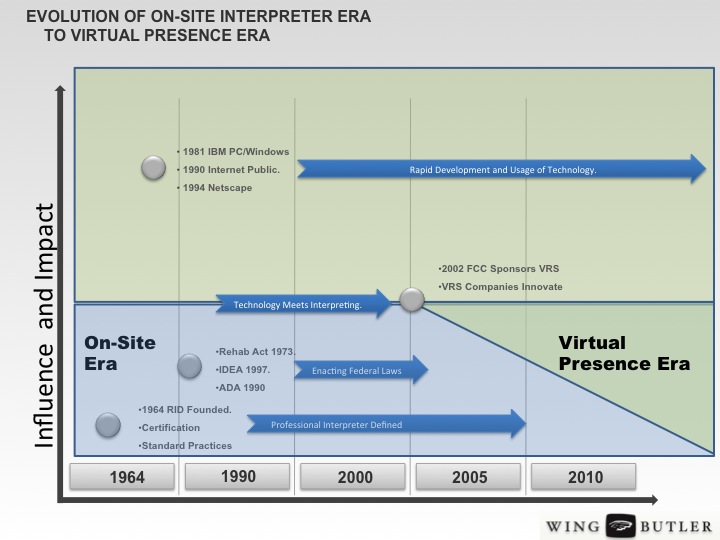
Whether we were paying attention or not, sign language interpreters experienced their own evolutionary “puff” moment in 2002, which began the slow extinction of the on-site interpreter. Not the physical appearance of an interpreter to an assignment, but more the delicate social ecosystem and the values that drive it. We moved from an on-site interpreting era to virtual presence era.
Standing On the Shoulders of Interpreter and Technology Pioneers
Several years before the interpreting industry’s evolutionary shift, I was walking through the halls of my local college. I spotted a simple sign written with marker, “Sign Language Interpreters Needed.” With only “Coda” as my credential, I was hired on the spot. What I thought was innate talent and unique brilliance, gave way to common sense and even compelled humility, thanks to the pioneers and builders of the interpreting profession who were bold enough to share with me the legacy of our interpreting community. I was the benefactor of a series of events and individual efforts, a “Big Bang” which caused a positive set of career oriented circumstances. In my article, “Interprenomics: a decoder ring for sign language interpreters” I identify the series of primary events that are responsible for the evolutionary foundations of the sign language interpreting economy—the formation of the sign language interpreting industry. I see them as follows:
- Founding of Registry of Interpreters for the Deaf (RID): The beginning of professional standards, practices, and certification for sign language interpreters.
- Enacting of Federal Laws: The Education of the Deaf Act (1986), The Rehabilitation Act (1973), Individuals with Disabilities Education Act (Reauthorization 1997), Americans with Disabilities Act (1990). These laws embedded the role of the sign language interpreter in mainstream America.
- Reimbursement of Video Relay Services: In 2002 the U.S. FCC begins the reimbursement of interstate VRS providers via the interstate TRS fund.
Meanwhile another “big bang” was occurring. The roots of technology were moving across America. Most of the web technology we experience today came about from developments from the 90’s.
- Introduction of the Internet: On the heels of IBM’s PC and Microsoft’s Operating System the internet goes public in 1990. Netscape creates a point and click browser and gives it away.
- Fortune 500 and Startups Go Virtual: 1995 – 1998 gave birth to Amazon.com, Google.com, and Disney. The amount of users on the network at this time 300 million only to grow to 1.1+ Billion today.
The Moment Everything Changed
While the transition from an onsite era to a virtual presence era from a historical perspective is beneficial, some interpreters missed the subtle change in values that drive the work. You see, while we were all enjoying rising pay, unprecedented demand for our services, legislative protection of our profession, technology began to unravel the foundations of our young profession, “throwing the baby out with the bath water.”
During the onsite era the delicate ecosystem/economy of sign language interpreting sought to keep Deaf-centric values at the heart of the work. And as Lynette Taylor mentions in her Street Leverage Live presentation “The Modern Questor: Connecting the Past to the Future of the Field,” she suggest that the interpreting industry moved from a Deaf-centric locus of power to an interpreter centric locus of power during the rise of interpreter related legislation. She also suggests that our work is moving away from Deaf values, and the interpreting industry has made a shift to a market-centric locus of power. Examples include:
- Telecommunications Access Legislated: 1998 Telecommunications Accessibility Enhancement Act (TAEA)
- Technology Meets Interpreting: 2002 FCC Sponsors VRS and in 2003 Sorenson develops VP-100 as first to market, in which many companies follow.
The Interpreter’s Evolutionary Traps
2002 marks the erosion of on-site interpreter era values. The collision of interpreter values with technological advances and the increased adoption of production oriented values has decoupled the relational aspects of an interpreter’s art from the work of interpreting. While the erosion is more readily viewable in the VRS industry, there is no safe-haven as information age efficiencies (Outsourcing, Digitizing and Automation) seek to change our world. Consider the office receptionist and the phone tree.
- Outsourcing: The idea that the quality of work done locally can be transferred to another location (not necessarily off shore) that favors lower labor rates, and equal or better quality.
- Digitizing: The transference of “flesh and blood” activities/work into bits of data.
- Automation: Once assets are digitized, the effort to duplicate the data is near effortless.
The Evolution of Values
When considering virtual world traps we can’t ignore the casualties of onsite era values. While terms like relational, artist, professional services model, and quality are all value descriptors for the onsite interpreter, it is the “Deaf heart” that begins to fade within our work. This loss is only galvanized by the traps spoken of previously.
This evolution is only intensified as the sign language interpreting industry introduces “Millennial” interpreters, generations apart from the foundation building “Boomer” interpreter. Consider a millennial interpreter’s perception of technology and the impact, or not, in their everyday work.
Onsite Era Values
- Relational
- Artist
- Professional Services Model
- Quality = Certified
- Specialty Skillsets (Legal, Medical, etc)
- Success through reciprocity
- Value Negotiation
Virtual Presence Era Values
- Transactional
- Production Model
- Quality = Qualified
- 1 Skill Fits All
- Success through statistical performance
- Non-negotiable rate & fixed value
The Next 50 Years – Become Untouchable

Wing Butler
Certainly technology isn’t going away, nor will its progression subside. Therefore, information age traps will remain, and technology will exponentially become a powerful vortex aimed at the onsite interpreter. While technology may change how we access the work, our industry doesn’t have to fall victim to digital era traps. In order to avoid extinction interpreters must become untouchable by becoming one of these three; “special” or specialized in the work, “anchored” to a location, and constantly re-skilling your brand. I know many interpreters who experience this protection now. Notwithstanding, this doesn’t answer the industry problem.
How does the sign language interpreting industry preserve onsite era values? Or better, Deaf-centric values? I’d like to recommend 5 essential keys for any interpreter or interpreting organization to evolve successfully in the information age.
1- Protect Value of Certification.
Without certification we have nothing.
2- Collaboration with Partners.
Synergy with government, consumer, and employer partners creates value to the industry. Does the interpreter or interpreting organization have direct relationships with State, private sector stakeholders and Deaf organization heads? Is there enough synergy to negotiate transactions on behalf of the industry?
3- Synthesize Leadership.
Identify interpreters with leadership talent, infuse them with the interpreting industry’s legacy, and ignite passion in them by empowering them to build relationships that support growth objectives.
4- Create Learning Culture.
Participate in sharing knowledge, wisdom and experience between boomer interpreters and millennial interpreters. Leverage Generation X and Y to facilitate understanding. Value experienced mentors and add to the value of their work.
5- Become a Media Company.
Use technology to amplify the voice of the interpreter. Organizations that represent interpreters will need to embrace web 3.0 realities by seeing themselves as a media and content marketer. Broadcasting not only provides transparency and leverages crowd sourcing towards a meaningful movement, but is a valuable tool to building unity, identity and relationships. Broadcast cheaply, regularly and often.
Certainly you have your own ideas? I’d like to hear them.
>> To see slides from Wing’s presentation click here.

Category: Business & Technology, Talks & Interviews


Hi Wing!
Thanks for the thought/reflection provoking post. I’ve had my own encounters with profesionalism vs. more tradidional expectations and values regarding interpreter behaviour and attitudes. I am very reticent to become a MikeTV terp. I love interacting with the PEOPLE. I want to build rapport in person, provide service on-site, be available for the unexpected and enjoy good relationships with the D/HH/DB and hrg communities. When this gig is up, I plan to embark on a new career…something in the arts. youtube shelllium
HI ya Shelly. Ahh your comments exhibit the true found in many of us. Its the people (culture) that attracted many of us to this field. Best of luck when you embark on a new career path, and keep up the good art of interpreting…the gig isn’t up yet. Grin.
Fantastic presentation! I felt like you described my “interpreting life” exactly as you experienced (including the sneaking out and getting busted). More importantly we have to be aware of our history and what the future may bring to affect the Deaf community and our profession. Thanks for a job well done and for bringing us StreetLeverage!
HI there John. The credit for StreetLeverage goes to Brandon Arthur. I’ve appreciated his support for pushing me and other fantastic authors to publish relevant and current topics. It’s conversations that we all have but don’t have a forum to refine. Thank you for participating in the evolution of the interpreter.
Whoa, as a Boomer, I’m reeling with that vision you painted of our new reality, Wing, but I see that you’re right. We can’t go backwards. I appreciate how you described it in terms of two opposing sets of values. Thanks for your astute analysis.
HI there Anna,
Thank you for your kind words. Perhaps another article is in order regarding the value conflices in generations from Boomer, Y, X and Millenials.
I recently read an article that pointed out that the 2009 High School graduating class was the largest graduating class in the history of the US. If I do my math correctly, they’ll be graduating shortly and entering the workforce. Certainly we’ll see ITP students turned young professionals share in the interpreting industry with a whole new set of world views and perspective on the work.
Wing, I enjoyed watching this presentation very much, and shared it with some interpreter friends. I have the benefit of experiencing both VRI settings and community settings as one of the few interpreters in a fairly small community. A piece of your presentation talked about the community and giving ourselves wholeheartedly to it. When I went through the ITP we were warned to have boundaries such as leaving the room during medical assignments so there isn’t so much chatting and sharing during free time (I appreciate it for minimizing my chances of getting sick too). But I worry about how to keep a balance between being professional and being open to the relationships with people. Do you, and others reading this, have thoughts about appropriate boundaries?
HI there Katie,
Thank you for sharing this article with your interpreter friends. It’s committed professionals like you that are helping to evolve the interpreter of the future. In a very real way our time is now to carry on the work of our interpreter pioneers.
I can also appreciate your concern about appropriate boundaries, there always seems to be shades of grey that we work within. It’s a character trait of a “professional” laborer as compared to “blue collar” worker where every decision is made for us and the expectation is to leave heart and mind at the door.
The fact that you wrestle with these scenarios, as we all should, is a part of the “untouchable” elements I spoke briefly about in the last paragraph of this article. The specialization aspects of our work is the asset we should embrace, it protects the value of the interpreter. The reality is that those who deepen specialist knowledge and become adept at the business jargon of their specialty will make it harder for their careers to fall prey to virtual world traps. Professional interpreters will always remain relevant because of it.
With that said, I believe you asked a specific question of the audience on our experience in maintaining appropriate boundaries, I digress.
Two articles come to mind immediately, although I can also see the theme thread in other articles on Streetleverage too, that explore the very concern you mention; boundaries.
- Trudy Suggs “Deaf Disempowerment and Today’s Interpreter”
- Wing Butler “Does Social Networking Impair Sign Language Interpreter Ethics?”
I bring them up to say that the understanding of appropriate boundaries is in high debate and seems to come down to a personal journey to define, as each of interpreter is linked to the Deaf community in such diverse ways. Certainly, interpreters you network with can highlight their conclusions.
I’ll never forget a one on one conversation with Carla Mathers after a legal workshop she presented at, a specialist in legal interpreting who I have high regard for, gave me the benefit of her experience by saying, “While there are standards,everything you encounter in interpreting will “depend” on the context of the environment”. After which she repeated over and over, to drive the point home to a slow student (me), “It depends”, “It depends”, “It depends”, after every cornering question I could come up with. lol.
Can you guess what I’m going to say next? It…… . Good luck in finding the right balance. I’d be interested in the thoughts of our readers here on how they define ‘appropriate boundaries’ within their work.
Hi Katie (and Wing!)
I have found that too- it depends, it depends it depends…! My Interpreter mentor tells me the same whenever I present a theoretical dilemma…and yes, it can drive me nuts trying to think of how I would deal with each and every possible outcome- because they are infinite!
As a newly qualified interpreter who has been involved with the Deaf community for many more years than I’ve been interpreting, I am finding that one of the skills we must bring to our jobs is trying to get in-tune with the people we work with when trying to define what’s an appropriate boundary. And it’s definitely a ‘trial and error’ process (e.g. ok next time I won’t spend my lunch with this Deaf person but it’s ok that this is not a ‘rule’ for every Deaf person I work with).
A lot of Interpreters I meet nowadays, who are training or have qualified about the same time as me, do put such rules on themselves, because perhaps it is easier to follow one’s own strict guidelines. I have heard things such as ‘I would never socialise with the Deaf people I interpret for’. Perhaps these interpreters strive for the Blue collar code that Wing mentions.
For me, I think it’s useful to ‘listen to the rules so you can break them’ in relation to what ITP has said about leaving the room in medical situations. Sometimes you might feel it’s appropriate to do this, other times, it might be that the Deaf person really needs to talk about what’s just happened medically, or they just want a natter. Either way, in situations like this, the words of my tutor from my own interpreting training comes to mind: Do what is human!
When we interpret, we work with Deaf people- they become our colleagues, effectively. Is it common practice for colleagues to not talk to each other when they are not ‘working’? I don’t think so!
Thanks for the article- and thanks for evoking such an interesting discussion!
Thank you Wing and Sophie. Even after 10 years of ‘practice’ this job is never black and white. I do appreciate your comments and perspectives. This is an excellent forum to bounce ideas off each other, and feel comfortable and supported.
I don’t enjoy being a virtual presence. I think I’ll move to Portland or Seattle and re-brand myself as an “artisanal” interpreter.
Hey there Dan,
I second that! Although, I’m going to stand in place and try the “artisanal” thing at home. Love you Seattle and Portland. Grin.
Can I just say for the record that there are times when its BAD to have a camera capture and freeze forever a highly unappealing facial expression. (insert flat face here…..maybe a grin)
Wing, there is another factor which I think plays into the virtual industry becoming what it is today, beginning with the early laws mandating interpreters, culminating in the ADA and the most recent incarnation of IDEA. The mandates created a demand for interpreters. In the ensuing vacuum, “training” programs sprang up to fill the void.
After a few decades of experimentation (remember the 9-week long programs, anyone?) most I[TEP]Ps look pretty much the same, and have a similar premise: take a person wholly from outside the Deaf community, run them through the coursework, and assuming they do well in school (grade inflation in the US is a separate topic of discussion), they emerge a fledgling interpreter. Interpreters, therefore, can be produced en masse.
Add to that the certification process. Any candidate can take the certification exam du jour and assuming they pass, they supposedly meet the minimal standards for entry-level practice. Ignoring, for the moment, the gap between program graduates and certified interpreters, this makes another assumption: once mass-produced, interpreters can be measured by a fixed yardstick to determine basic fitness.
All very efficient and modern. Why then, would agencies — either VRS or those agencies not rooted in the Deaf community who provide ASL/English interpreting as part of their catalogue — do anything other than treat the interpreter like a widget? If the assumptions behind our whole system of recruiting, training, and credentialing indeed hold, then what they’re doing simply takes those assumptions to their logical conclusions.
However, VRS and non-Community folks are clearly facing some problems in just that arena… hence the turnover, unionization, and community backlash. Therefore we need to challenge the assumptions (for logic fans, this is modus tollens). Indeed, we have begun to do so. We introduce mentorships, continuing education, and so forth. I would argue we need a more radical approach, perhaps one more like Paula Browning’s idea of a Guild, complete with apprenticeships. Our lofty attempts to compare ourselves to physicians and lawyers have fallen short.
I could go on (oops — too late!). But this’ll do to start.
Dan, I’ve loved every word! Well said, well thought out, and you’re exactly right on! I’m thinking we ought to hang out and wax philosophical on industry change.
Aloha Wing —
Excellent, thoughtful and well-prepared commentary!
The various issues you brought up relating to the evolution of interpreting industry alongside the emergence and dominance of technology in the field is spot-on. I’ve seen the multitude of issues relating to the Deaf community’s needs/wants/demands around the VRS industry become manifested so many different ways and usually from a Deaf perspective.
It’s refreshing to get the “interpreter’s” take on where ASL interpreting is going in parallel with the emergence of virtual and transaction-based interpreting services. Your examples and metaphors were fantastic and memorable!
Aloha Joshua,
Thank you for taking the time to comment and your words of encouragement.
Take care.